
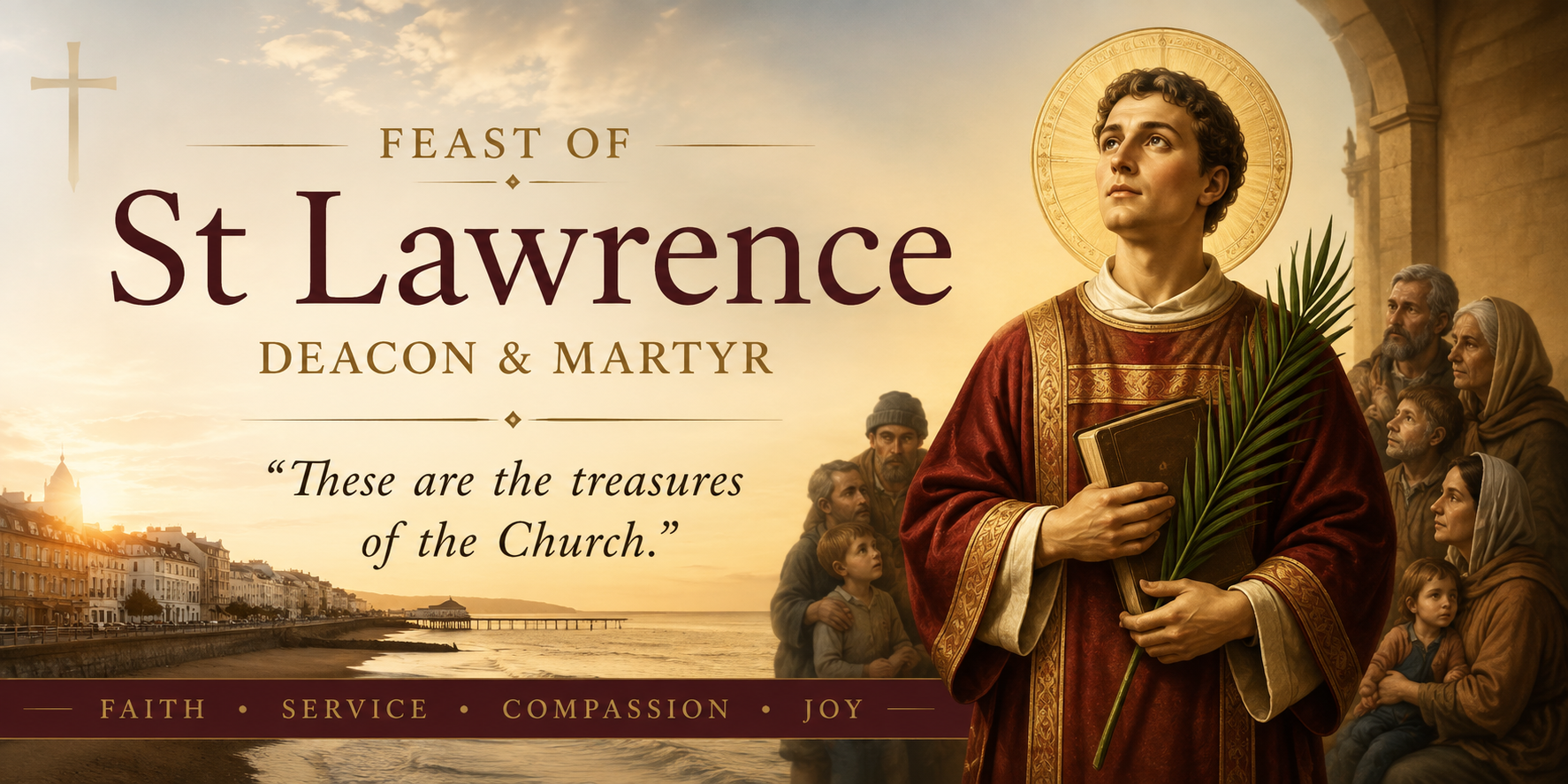
When we think of St Lawrence, we can often get distracted by the method of his martyrdom. But before Lawrence was a martyr, he was a deacon; and before he gave his life in one final act of witness, he had already spent his life giving himself in service to Christ and His people.
As a deacon of the Church of Rome, Lawrence was entrusted with the Church’s resources. But his responsibility went well beyond simply looking after money and possessions. He was charged with distributing those resources to those most in need, the poor, the widows, the sick, and those who had no one else to care for them.
Lawrence understood something fundamental about diaconal service: the Christ we encounter at the altar is the same Christ we encounter beyond the church doors.
The hands that reach out to receive Christ in the Eucharist must also be willing to reach out to those who are hungry, lonely, struggling or forgotten. For Lawrence, worship and service could never be separated. This love for Christ was instrumental in drawing him towards those whom Christ loves.
This is one of the reasons why St Lawrence speaks so powerfully to me. He’s a reminder that service is more than just words; it requires action.
Much of my own formation for the diaconate has been shaped by the social teaching of the Church and by considering how that teaching relates to poverty in our coastal communities. We don’t have to look very far to see both beauty and hardship existing side by side.
Visitors see the sea, the sunshine and the beauty of our coastline. But behind that familiar picture postcard view are people carrying burdens that are often unseen: loneliness, financial pressure, uncertainty about the future, and sometimes simply the feeling of being overlooked.
Perhaps that is why we can hold St Lawrence particularly close to our hearts.
When the Roman authorities demanded the treasures of the Church, Lawrence gathered the poor and presented them instead.
“These are the treasures of the Church.”
It is difficult to imagine a more challenging or beautiful understanding of what the Church is called to be.
The world can so easily measure value through wealth, influence, achievement or success. Lawrence saw something different. He saw the dignity of every person created in the image of God. The poor were not simply people to whom the Church offered charity. They were his brothers and sisters in Christ.
And perhaps that is the challenge Lawrence leaves with us today.
The Gospel speaks of the grain of wheat falling to the ground and dying so that it may bear much fruit. Lawrence lived those words. His martyrdom was the final expression of a life that had already been given to God and to others.
We may never be called to give our lives in such a dramatic way. But every day offers us opportunities to give something of ourselves — our time, our patience, our compassion, our attention.
Sometimes the smallest act of kindness may be far more valuable than we realise. It’s an action that touches the hearts of those we serve.
And perhaps, when we begin to see people in that way, we begin to discover what Lawrence discovered: the true treasures of the Church are not things at all. They are people, people created, loved and redeemed by Christ.
Deacon Neil